
“Who am I?”
It sounds like such a simple question. Almost childish in its simplicity. The kind of question you imagine philosophers debating over candlelight centuries ago, or teenagers scribbling into journals late at night while trying to figure out where they belong in the world.
During my 15 odd years working with people struggling with Anxiety and Depression and PTSD, we explored this very topic every week. And, every week I grappled with answers along with every member of the group, never really settling on an answer.
And now...the older I get, the less straightforward the answer becomes.
Because who exactly am I now?
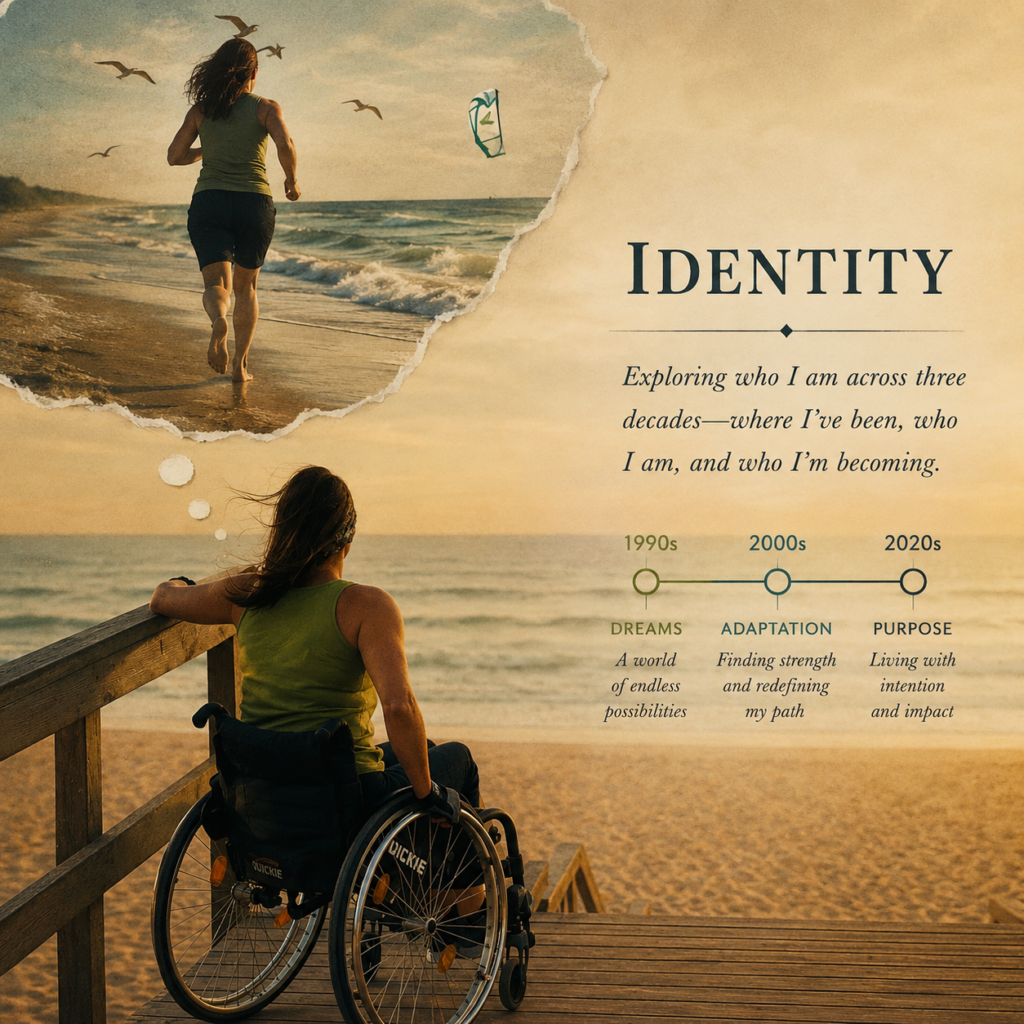
Am I the girl I once was — vibrant, ambitious, energetic, certain that life would unfold in a particular way? Am I the woman who built dreams with both hands (and working legs), convinced there would always be enough time, enough health, enough strength to become every version of herself she imagined?
Or am I the person I became after life interrupted everything?
Over the past three decades, I have changed in ways I never anticipated. Some changes arrived naturally with age and experience. Others arrived violently, without invitation, reshaping not only my body, but my identity itself. Disability has a way of forcing a confrontation with selfhood that few people truly understand unless they have lived it.
You grieve things that are invisible to everyone else.
Not only physical ability, but imagined futures.
Versions of yourself that never got to exist.
Goals that no longer fit inside the boundaries of your reality.
Dreams that quietly expired while the world carried on around you.
And somewhere amidst all of that, you begin asking questions you never thought you would have to ask.
If I can no longer do what once defined me, who am I?
If my ambitions have changed, who am I?
If my world has become smaller in certain ways, has myself become smaller too?
That is the cruel trap identity can become. We spend so much of our lives attaching ourselves to what we do, what we achieve, how productive we are, how independent we appear, how useful we are to others. Then life changes the terms of the agreement, and suddenly we are left staring at ourselves without the labels that once felt secure.
Kind of where I am right now…
I sometimes feel like a shadow of my younger self.
Not because I have no value now, but because I remember her – walking Wanda – so vividly. I remember her momentum. Her certainty. Her untouched optimism. I remember the things she believed she would accomplish, the places she thought she would go emotionally, physically, spiritually. I remember the version of womanhood she imagined for herself before pain, limitation, exhaustion, and grief rewrote parts of the story.
And perhaps the hardest part is that the world often celebrates transformation only when it looks triumphant.
People love stories of overcoming.
Of conquering.
Of rising stronger.
But what about those of us still learning how to simply exist inside the aftermath of change...especially when change happens again and again...and again?
What about those of us who are grateful beyond measure and grieving simultaneously?
Because I am grateful.
Profoundly so.
Grateful to still be alive.
Grateful for the privilege of motherhood.
Grateful for the indescribable joy of becoming a grandmother.
Grateful for love, connection, memories, laughter, and moments of unexpected beauty that still find me even on difficult days.
There are countless people who never got these opportunities. I know that deeply.
And yet gratitude does not magically erase longing.
It does not automatically answer the question of selfhood.
It does not instantly create self-actualization.
It does not remove the quiet ache of feeling disconnected from the person you once thought you would become.
That tension is difficult to explain to people. Society often treats gratitude and grief as opposites, as though one cancels out the other. But they coexist more often than we admit.
I can be deeply thankful for my life while still mourning parts of myself.
I can cherish my family while still wondering where I disappeared to along the way.
I can appreciate survival while still struggling to feel fully alive within my own – seated – identity.
Perhaps that is what this season of life truly is for me — not a search for the woman I used to be, but an excavation of who remains underneath all the loss, adaptation, survival, and reinvention.
Because maybe authenticity is not found in returning to an earlier version of ourselves.
Maybe it is found in learning how to sit honestly with every version we have been.
The young dreamer.
The grieving woman.
The exhausted survivor.
The mother.
The grandmother.
The woman learning to live inside limitation without allowing limitation to define the totality of her existence.
Maybe “Who am I?” is not a question with a fixed answer at all.
Maybe it is a lifelong unfolding.
A continual meeting and remaking of self through every joy, every wound, every disappointment, every unexpected detour.
And perhaps the real courage lies not in having a perfect answer, but in continuing to ask the question anyway.
Even now.
Especially now.